Commentary, Oct. 04, Jos Algra
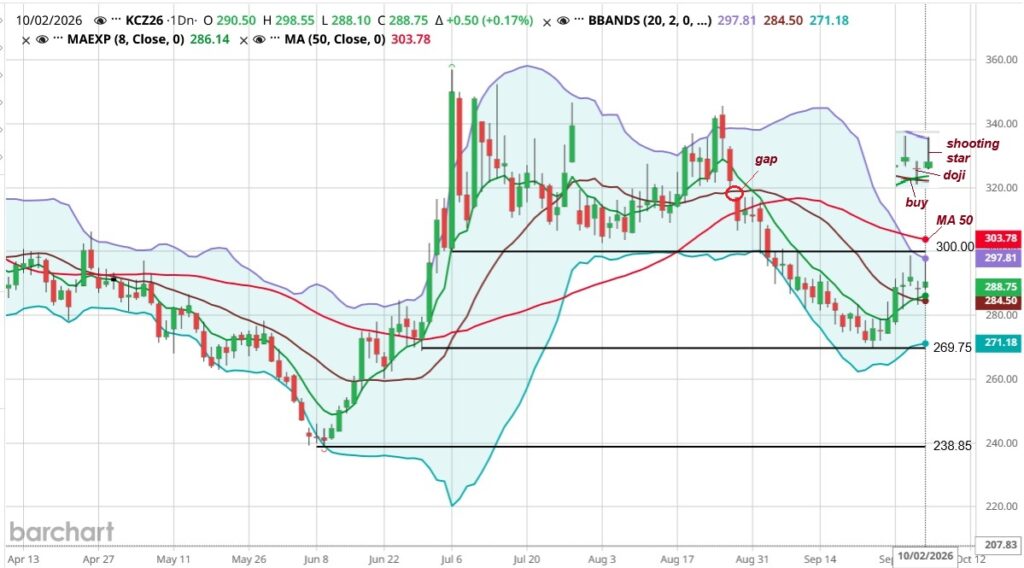
The price of coffee in New York continued to fall, bottoming out at 269.75. It then began to rise, touching 298.80 on Wednesday. Thursday saw a drop to 283.30, though the day ended with uncertainty regarding the market’s direction. On Friday, the upward trend resumed, but the price hit a ceiling at 298.55 before pulling back to close at 288.75.
Coffee prices were initially under pressure due to the significant increase in expected production for this harvest, particularly in Brazil. Sentiment later shifted, and prices began to rise. Low rainfall in Brazil during the flowering season could impact production for the 2027/28 cycle. A weakening dollar also contributed to the rise in coffee prices. Underlying these movements is uncertainty regarding the potential impact of a “Super El Niño” and the geopolitical situation.
There is a number of contradictory and confusing indicators. The daily chart shifted from oversold territory—where it had been for a month—to overbought in the last week, a move that could trigger a correction. A “buy” signal (bullish) appeared between Wednesday and Thursday. Thursday saw a “doji” pattern indicating indecision, though with a slight bearish tilt. On Friday, the price initially rose by more than 10 cents but then fell by nearly the same amount, forming a “shooting star” pattern; this suggests a potential bearish reversal following an uptrend. The price remains well below the 50-day moving average (MA 50).
In which direction will the current price range break? The 280-cent floor has been broken, but a new one has formed around 270. If this level breaks, the price could drop to the next support near 240. On the upside, there is a ceiling around 300 cents that has not yet been breached. All that’s missing is a crystal ball.
Support: 283.30, 269.75, 260.15, and 238.85. Resistance: 298.80, 300.25, 303.80 (MA50), and 316.90–319.80 (gap).
In the Commitment of Traders report,, combined futures and options Open Interest rose by 5,220 contracts, from 192,298 to 197,518. Futures-only Open Interest increased by 6,315 contracts from 151,575 to 157,890 last Thursday. Daily volume averaged 25 thousand contracts.
Managed Money‘s position initially widened by 4,756 contracts (from a net short of 1,716 to 6,472) but subsequently narrowed by 2,979 contracts to a net short of 3,493. Spreads, reflecting the extent to which each non-commercial trader holds combined long and short positions, rose by 2,188 contracts, from 65,275 to 67,463.
Commercial long positions increased by 4,588 lots, from 54,985 to 59,573. Commercial short positions rose by 1,257 lots, from 89,747 to 91,004. Roasters continued to lock in contracts while prices were low, whereas producers entered the market when prices began to rise.
Index funds reduced their net long position by 1,194 contracts, from 35,137 to 33,943.
Sentiment on the New York exchange has become slightly less negative.
Certified stocks on the New York exchange hit a low of 223,976 bags in August—the lowest level since February 1999. In September, they rose by 36,678 bags to 260,654, driven primarily by the arrival of 59,909 bags from Brazil (bringing the Brazilian total to 66,657). Some analysts claim that if stocks rise to 500,000 bags, the exchange price will plummet. That level was reached in March–April of this year.
CONAB adjusted its 2026/27 crop forecast from 66.7 million to 67.6 million bags—comprising 48.2 million bags of Arabica and 19.4 million of Robusta. CONAB typically issues one of the lowest crop forecasts; only the IBGE forecasts a lower figure: 66.8 million bags. The average of all forecasts is 72.6 million bags, with a range of 66.8 million to 76.1 million.
According to a preliminary report by Cecafé, Brazil exported 3.7 million bags in September, 12% less than in August (4.2 million) and 3% less than in September 2025 (3.8 million).
Warehouses in Brazil are reportedly packed with coffee, and buyers are unwilling to accept further deliveries due to a lack of storage capacity. There are also reports of many new warehouses currently under construction.
At this week’s Coffee Dinner in Switzerland, there was a consensus that the situation in Peru is critical, worse than in recent years. This was the main topic of conversation, as we had previously noted in the blog. Supplies are low and defaults are frequent; differentials have surged to +70/+80. However, traders note that while these levels may be quoted, no one is actually paying them, and buyers are reluctant to contract more Peruvian coffee due to the associated risks.
Everyone has turned to Mexico and Central America for coffee supplies. Although the harvest has reportedly started early, it is insufficient to meet short-term demand. Furthermore, the region remains relatively dry due to El Niño, which is expected to peak toward the end of the year, potentially impacting harvest volumes. Those with coffee available for prompt shipment are making a killing.
Buyers are also struggling to cover their purchasing schedules for the first quarter of 2027. The coffee trade and industry are getting very nervous.
A bright note for buyers: now that the main harvest is getting underway, differentials for Colombia have softened … dropping 2–3 cents from the roughly +80 level for Excelso!
Jos Algra is an international consultant with more than 40 years of experience in coffee and working with producer organisations.
This blog was originally published in Spanish in Claase.