Commentary, August 23, Jos Algra
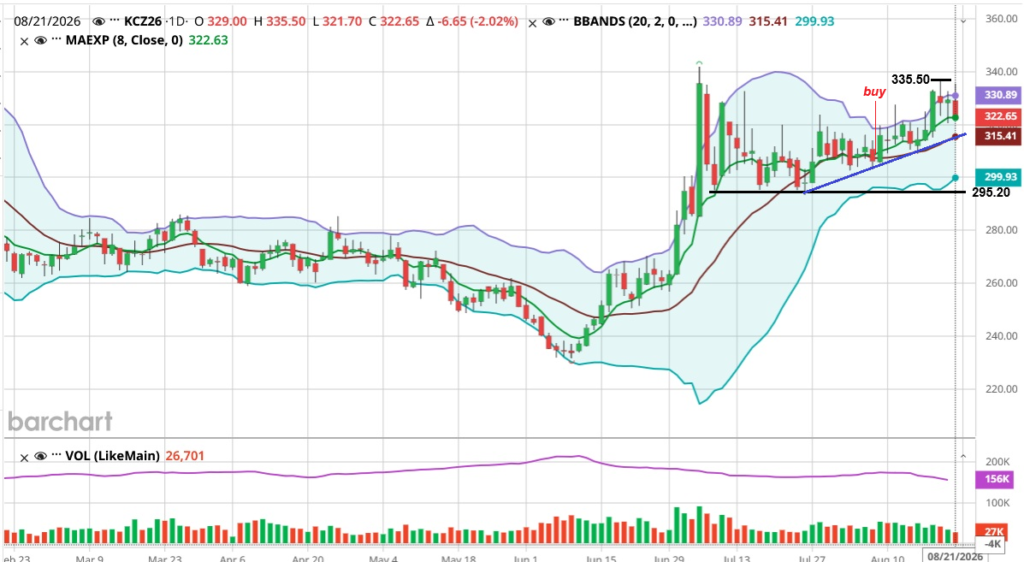
During the week, the coffee price of December position in New York rose to a high of 335.50, the highest price since July 6. On Friday, however, it fell 6.65 cents and closed at 322.65. Friday, August 21, was First Notice Day for September, which has a premium of more than 36 cents over December; the coffee shortage in the short market continues.
The biggest surge was on Tuesday when the price rose 14.55 cents in the settlement. This was influenced by the powerful earthquake that struck Colombia on Monday, which caused many deaths, injuries, and disappearances, as well as extensive damage. The epicentre was near important coffee-producing areas. While it did not affect production, it did impact producers’ homes, processing infrastructure, and roads. Exports through the port of Buenaventura, which handles 60% of Brazil’s coffee, were temporarily suspended.
The Brazilian harvest continues to be delayed. The Conilón (Robusta) harvest has been completed, but the Arabica harvest is only 91% complete, compared to 98% at this time last year. Exports appear to be settling at around 3 million bags in August, the same as in July and below the monthly volume from March to June.
The increase in production volume this harvest is not yet noticeable. Drier weather is expected in Brazil, which should accelerate the harvest; the prospect of greater coffee availability is putting downward pressure on prices.
Concerns about the impact of El Niño, which is gaining strength, and the global geopolitical situation are also contributing factors. The United States’ debt has now surpassed $40 trillion (4 followed by 13 zeros). This has a very negative impact on the United States and the world. Finance Secretary Scott Bessent is trying to combat this by buying some of that debt. Buying long-term debt with short-term loans only worsens the situation; it’s like trying to pull yourself out of the mud by your own hair.
The daily price chart shows that the Bollinger Band has indeed broken upwards, as anticipated in the previous blog post (Return to the past?), and it continues in a buy signal. The question is whether the upward trend will continue or if it peaked on Friday before surpassing 340 cents again. There are few resistance levels to the upside and several support levels, with the main one at 295.15-295.20.
Supports: 308.95, 295.15-295.20, 285.25, 256.90, 250.55 and 231.80. Resistances: 335.50 and 341.80.
In the Commitment of Traders report one can observe that combined Open Interest in futures and options fell by 24,828 contracts over the past two weeks, from 227,092 to 202,264. Open Interest in futures alone decreased by 16,548 contracts, from 172,821 to 156,273 last Thursday. Daily Volume dropped from 53,000 to 27,000 contracts.
Net Fund Position increased by 4,642 contracts, from 10,402 to 15,044 net long. Spreads, which reflect the degree to which each non-commercial trader holds combined long and short positions, fell by 22,489 contracts, from 95,576 to 73,087. Many funds are not currently taking positions.
Commercials long position decreased by 4,463 lots, from 53,995 to 49,532. The short position of Commercials initially increased by 6,597 lots, from 100,069 to 106,666, but then decreased by 5,657 lots to 101,009, an increase of 940 lots in two weeks.
Index funds have seen little change in their net long position (+366 to 34,114), but have reduced both their long (-945) and short (-1,311) positions.
These are considerable changes. The movement has slowed, but the funds are betting more on the upside, which is reflected in the price. Producers are maintaining a good volume of fixed contracts, but roasters are remaining largely on the sidelines in the face of the price increase; the buyers are the funds.
The average harvest forecast for 2026/27 in Brazil is 47-48 million bags of Arabica and 24-25 million bags of Conilon (Robusta), for a total of 71-73 million bags, within a range of 66.2 to 76.1 million bags.
The Archer Consulting agency lowers that forecast considerably to 43-47 million bags of Arabica and 19-24 million bags of Conilon, for a total of 62-71 million bags. This would mean that CONAB, for the first time in many years, would be correct with its forecast of 66.2 million bags.
This forecast appears to be the current consensus, but I have not been able to confirm it. On the contrary, several sources have reiterated their forecasts of a record harvest in Brazil, and there are reports of warehouses overflowing with coffee in various regions, which will begin shipping in September; however, much of it will be small-bean and of poor quality.
Archer Consulting applies this new forecast to data from the USDA FAS, published in July (see the July 27 blog post, “Beyond the panic, and now what?”). If the harvest falls to just 62 million bags, global stocks will decrease from 26.3 million to only 16.4 million, slightly more than the 14.9 million bags consumed monthly worldwide.
If this occurs, it implies the continuation of the extreme coffee shortage and potentially a sharp spike in coffee prices. It seems an unlikely scenario, but it is important to continue monitoring reports on harvested volumes and the pace of exports. It is unknown whether the low export volume is solely due to delays or because production is lower than expected and coffee has been lost.
Archer Consulting continues its analysis: if, on the contrary, the 2026/27 Brazilian harvest exceeds 70 million bags and the next Arabica flowering develops as expected, then we need to brace ourselves. The next harvest could again surpass 70 million bags and even reach 75 million. That would put significant pressure on coffee prices.
A good Robusta flowering has been reported for the next harvest. The newly planted areas are already producing with good yields. It could be a record harvest, exceeding 25-27 million bags. It is possible that by 2030 Brazil will surpass Vietnam and become the world’s largest Robusta producer.
Peru’s National Coffee Board reports that coffee production could be 15-20% lower than last year’s harvest, from 4.8 million to 3.8-4 million bags in 2025. Some are even predicting a 40% drop.
The main cause is the lack of rainfall during flowering and bean filling, especially in plantations below 1,400 meters above sea level. The lack of rain could also affect the 2027 and 2028 harvests.
Added to this are increased labor costs, a higher incidence of pests, and the aging of coffee plantations. 75% of the plantations are over 15 years old.
Current prices are good for producers, but the coffee shortage has driven up wholesale prices and could affect fulfillment of shipments. Local prices may be higher than FOB prices.
As a result, Peruvian price differentials have skyrocketed in the supply chain. Grade 1 has risen from +30 to +40 in the last two weeks. Colombian spreads have also increased slightly. Excelso is trading at nearly +80, partly to offset the dollar’s decline against the Colombian peso. Following these two countries are Guatemala, where the SHB has risen by about 10 cents, Honduras (+5 cents), and Nicaragua (+2 cents).
The Colombian harvest is delayed, and production has fallen 11% in the last 12 months to 13 million bags due to bad weather caused by climate change. Exports have decreased 10% to 11.7 million bags, thanks to imports. Now that the El Niño phenomenon is emerging, droughts and high temperatures are expected, which will affect production.
Jos Algra is an international consultant with more than 40 years of experience in coffee and working with producer organisations.
This blog was originally published in Spanish in Claase: