Comment, August 9, Jos Algra
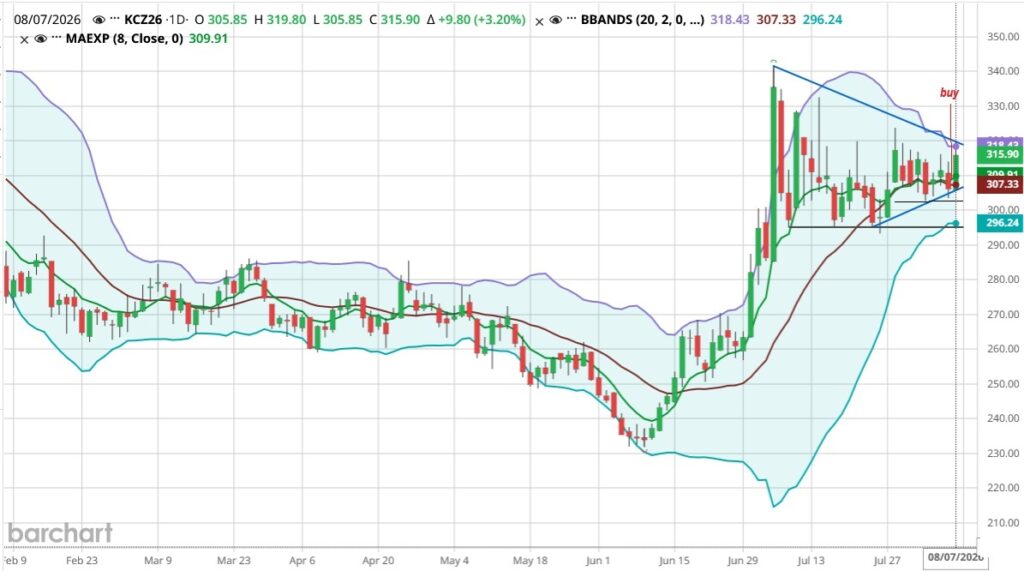
In the first half of the month, the price of coffee December position in New York fluctuated between a high of 323.75 and a low of 302.60. On Friday, it rose 9.8 cents to close at 315.90. September rose that day 13.90 cents to 335.55. The market remains heavily inverted, particularly for the nearby contracts, reflecting the ongoing short-term coffee shortage.
The coffee harvest in Brazil continues to progress slowly due to rains. Producers are rationing sales, the dollar is under pressure, making selling coffee less attractive, inventories remain low, and certified Arabica stocks in New York fell to their lowest point in 2.5 years on Friday to 244,172 bags, with only 3,250 bags pending certification. Brazilian exports in July fell 3% compared to June to 3 million bags.
On the other hand, the outlook remains for a strong increase in the Brazilian harvest to 72.5 million bags, and the USDA FAS forecasts a surplus of 9.9 million bags at the end of this harvest (see the July 27 blog post, Beyond the panic, and now what?). The market reversal point is expected from November onward.
After the extreme volatility in the first half of July, when the Bollinger Band reached a width of up to 94.35 cents, price volatility has gradually decreased, and the price has moved more laterally, with a floor at 295.15, that later rose to 302.60.
However, as can be seen in the chart below, the highs and lows are converging, and the Bollinger Band is narrowing, reaching a width of 22.19 on Friday. If this trend continues, it could generate a Bollinger Band squeeze, where it narrows so much that the price has to break out of the band violently, either upward or downward.
The daily chart went almost two weeks without giving either a buy or sell signal. The 8-day exponential moving average was stuck close to the 20-day simple moving average, which is the Bollinger Band pivot. Finally, on Friday a buy signal appeared.
Support level: 302.60, 296.25, 295.15, 285.25, 256.90, 250.55, and 231.80. Resistance level: 319.80, 323.75, 332.60, and 341.80.
The Commitment of Traders report shows that combined open interest in futures and options increased by 6,411 contracts over the past two weeks, from 220,681 to 227,092. Open interest in futures alone rose from 163,222 to 172,821 last Thursday. Daily volume fluctuated between 34 and 53 thousand contracts.
Net fund position remained virtually unchanged at 10,402 net long. Spreads, which reflect the degree to which each non-commercial trader holds combined long and short positions, increased by 5,007 contracts, from 90,569 to 95,576. Many funds are not currently taking position.
Commercials long position increased by 2,758 lots, from 52,582 to 53,995. Roasters are fixing some contracts, but not many at the moment. It’s summertime in the main countries in the North, when coffee consumption is traditionally low.
The short position of commercials moved little, rising 402 lots from 99,328 to 100,069. Few producers have been willing to fix contract prices. Many have finished harvesting; Brazilians are waiting.
The difference between the first and second positions on Friday was 19.65 cents at the close. In December, it reached over 30 cents. On Friday, certified stocks on the New York Exchange stood at 244, thousand bags (72% in European ports, 28% in the United States), a decrease of 20 bags in one week.
This is the lowest level since the end of 2023 (224 thousand), and we have to go back to the beginning of 1999 to see a lower volume. First Notice Day for the September position is August 21, and we can expect the volume to decrease even further.
Extreme short-term shortages. So, the market can be expected to continue in backwardation. This situation is not expected to reverse before November, when new harvest coffee will begin to arrive.
Producers in Brazil are cautious about sales: the volume and quality they can offer, how much they can store in their own warehouses, the price in the domestic market and in New York, the dollar-real exchange rate, and the liquidity they need.
A record harvest is underway in Brazil, which will eventually have to be exported. However, the percentage of low-grade coffee is high due to weather conditions during the bean’s development phase. Low-grade coffee is used extensively for domestic consumption, and as a result, there is greater availability of Conilon (Robusta) for export. Monthly volume rose from 182 thousand bags in January to 847 thousand in July.
Vietnam reportedly exported 396 thousand tonnes of coffee in July, 6.6 million bags! A 286% increase compared to July 2025. The Vietnamese harvest forecast may need adjusting. The abundant availability of Robusta is increasing export volume, but this doesn’t necessarily mean that consumption is increasing at the same rate.
There are better facilities for storing coffee in consumer countries – although storing conditions in Vietnam have improved significantly in recent decades – and it raises exporters’ liquidity. It is expected that large roasters will replace a significant amount of Arabica with Robusta in their blends, due to the price difference.
It doesn’t appear that the global trade crisis is temporary and that we will return to normal after going through this phase with the wars in Ukraine and the Middle East, the blockade of the Strait of Hormuz and of Bab al-Mandab (which provides access to the Red Sea and the Suez Canal), the energy crisis, and the disruption of supply chains.
Climate change has generated heat waves and massive wildfires in Europe, the United States, and Canada. Rivers have dried up, making transportation impossible, affecting industrial supplies, have reduced production at hydroelectric plants and have led to the closure of nuclear power plants due to a lack of cooling water. This crisis is not an isolated incident; it will be repeated with increasing frequency and severity.
Global trade has long been governed by the principles of efficiency, supply and demand, and the free movement of goods to optimize costs and time. In the current situation, companies are reacting by increasing stock reserves, changing suppliers, seeking alternative routes to obtain supplies and sell products, creating resilient supply chains; overcome a temporary problem, and then return to normal. But the current disruptions are not temporary, they are part of a profound shift in the foundations of the global economy.
Europe has quickly introduced new regulations to reduce the impact of climate change, combat deforestation, and so on. The United States is constantly changing import tariffs. Sanctions have been imposed on Russia and a range of other countries. China’s trade policies are not governed solely by supply and demand, costs, and efficiency, but primarily by strategic interests.
Regulations are changing faster than companies and supply chains can adapt. A new tariff from the Trump administration can completely disrupt a company’s business model. What’s needed is not crisis management, but a profound change in how a company is organized.
Trade policies largely determine which markets are accessible, which supplier offers the best option, and where it is worthwhile to invest. Companies must closely monitor government policies and the geopolitical situation. Those that recognise them and adapt early will be the most competitive, not those with the lowest cost or the most technologically advanced.
FAS USDA has programmed the release of their annual report on global coffee supply and demand for July 22, which normally is released in June.
Jos Algra is an international consultant with more than 40 years of experience in coffee and working with producer organisations.
This blog was originally published in Spanish in Claase: https://claase.org/analisis-de-los-precios-del-cafe