Commentary, Sep 21, Jos Algra
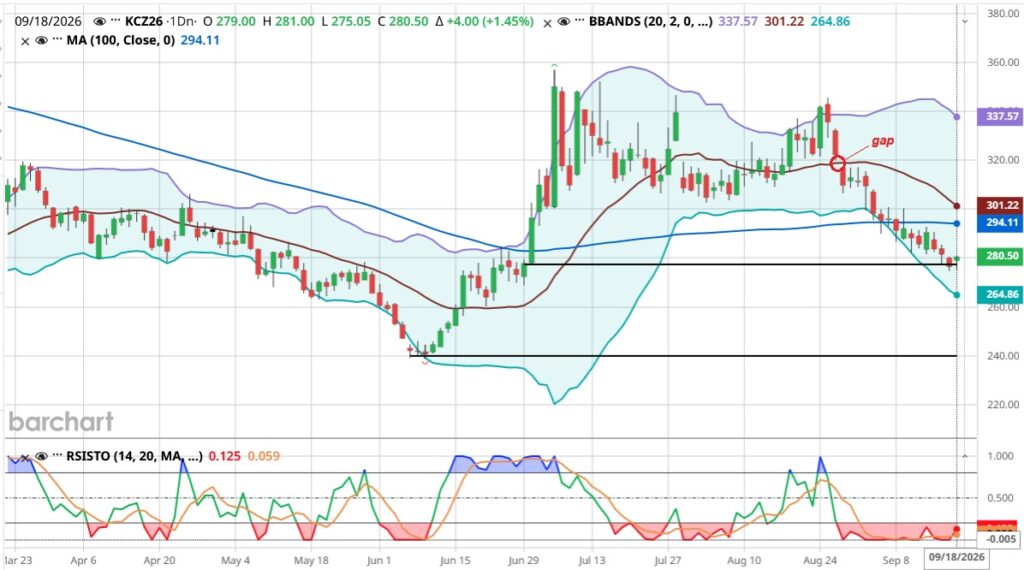
New York coffee prices continued their downward trend, breaking the 280 support level and touching a low of 274.60 on Thursday—the lowest price in two and a half months. On Friday, the price recovered 4 points to close at 280.50.
Coffee prices are facing increasing pressure from Brazil’s large harvest volume. The ICO also forecasts a surplus of 3 million bags—the first in five years. In August, Brazil exported 4.2 million bags, the highest level on record for that month.
On the other hand, certified New York inventories fell to 217,646 bags on Tuesday—a 27-year low—but by Friday, they had risen to 258,415 bags, surpassing levels seen a month and a half ago.
The New York market is heavily oversold—a condition that has persisted for nearly a month without triggering a price correction or a market rebound.
The 280 floor has been breached in recent days. It remains to be seen whether the support level around that mark can hold following Friday’s slight recovery. If not, prices could drop to the 260 and 240 levels.
To move higher, the price must first break above the 100-day moving average, currently at 294.10 cents.
Support: 274.60, 260.15, and 238.85. Resistance: 292.50, 300.25, and 316.90–319.80 (gap).
According to the Commitment of Traders report, combined futures and options Open Interest fell by 8,593 contracts over the last two weeks, dropping from 200,891 to 192,298. Futures-only open interest decreased by 3,680 contracts, from 155,275 to 151,575 as of last Thursday. Daily volume averaged 29.5 thousand contracts (ranging from 24.1 to 41.4 thousand).
The funds’ net position shifted by 8,861 contracts, moving from a net long of 7,145 to a net short of 1,716. Except for a brief moment in June of this year, funds have maintained a net long position since October 2023. Spreads – reflecting the extent to which non-commercial traders hold combined long and short positions – decreased by 6,952 contracts, falling from 72,227 to 65,275.
Commercials’ long positions rose by 3,334 lots, from 51,651 to 54,985, while their short positions fell by 6,950 lots, from 96,697 to 89,747.
Index funds reduced their net long position by 517 contracts, dropping from 35,654 to 35,137.
There is a palpable shift in the atmosphere of the New York market. After three years, funds have abandoned their bullish bets and adopted a net short position. Roasters continue to capitalize on the price drop to lock in contracts. Producers are further reducing their price fixings amidst the decline; they were forced to fix against the September contract and will eventually have to fix contracts against the December position. Many have incurred—and continue to incur—significant losses by delaying their price fixations, waiting for a price recovery.
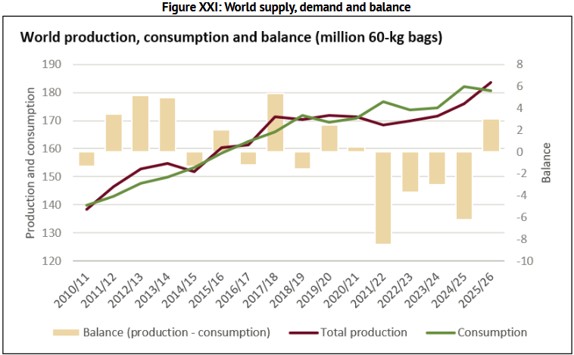
In its August report, the ICO notes that in 2025/26, production increased by 4.4% to a record volume of 183.6 million bags. Consumption fell by 0.9% to 180.6 million, resulting in a surplus of 3 million bags—the first surplus in five years.
In our previous blog post, The error we analysed Brazil’s monthly and annual export volumes. Due to a “system error” at Cenicafé, the projected export figure for August initially stood at under 3 million bags. Once the “error” was corrected, the figure jumped to nearly 3.8 million and subsequently to 4.0 million.
Updated data from Cenicafé now show that the August volume was even higher: 4.2 million bags, a 31% increase over August of last year and a 36% rise compared to July. This represents the highest volume ever recorded for the month of August across all categories: Arabica (2.9 million, +26%), Robusta (1 million, +54%), and 300 thousand bags of soluble coffee. The previous record was set in August 2024, with 3.8 million bags.
Conditions in Brazil remain favourable during this critical flowering stage, though the El Niño phenomenon could alter the outlook. Vietnam is increasing production for the 2025/26 harvest by 6%, reaching 29.4 million bags. Exports rose by 17.5% to 26.3 million in 2025, with an additional 13.7 million exported between January and August of this year, bringing the total to 22.2 million. As with Brazil, there is significant uncertainty regarding the impact the developing “Super El Niño” will have on the new crop cycle.
Producers in Peru have reported that the price differential for Grade 1 coffee has risen to +70/+80, though exporters state that no one is actually paying that rate. Faced with coffee shortages and high prices in Peru, buyers are turning to Honduras and the rest of Central America.
There are problems with the bookings, because the Panama Canal has a reduced capacity to lock ships through due to the draught and coffee is accumulating at the mills and ports, notwithstanding the reduction in production.
Researchers from the University of Viçosa and the Federal Institute of Espírito Santo have discovered bacteria capable of fixing atmospheric nitrogen, solubilizing phosphorus, and producing plant hormones. This discovery could potentially replace synthetic fertilisers, thereby reducing both environmental and financial impacts.
Two farms in Minas Gerais growing the same Yellow Catua coffee variety were compared over a period of more than fifteen years. One uses chemical fertilisers, while the other uses chicken manure. Thirty-eight bacterial strains were identified, including some local ones that were previously unknown. The organic method enriched the soil with genera that were absent from the chemically fertilised soils.
See Brazilian Coffee Soils Harbor “Hidden Bacteria” That Could Revolutionize Sustainable Farming.
Jos Algra is an international consultant with more than 40 years of experience in coffee and working with producer organisations.
This blog was originally published in Spanish in Claase: