Probando el piso

Comentario, 21 de sep, Jos Algra

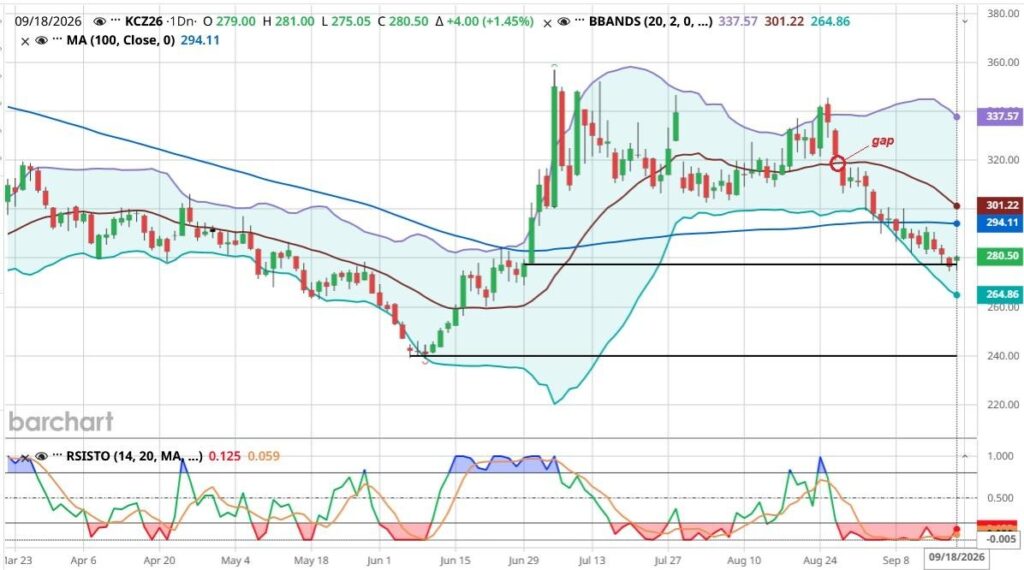
El pecio de café posición en Nueva York siguió su viaje a la baja, rompiendo el soporte de 280 y tocando un mínimo de 274.60 el jueves, el precio más bajo en dos meses y medio. Viernes se recuperó 4 puntos y cerró en 280.50. 

El precio de café está crecientemente bajo presión del gran volumen de cosecha en Brasil. La OIC también pronostica un excedente, 3 millones de sacos, el primero en 5 años. Brasil exportó en agosto 4.2 millones de sacos, el nivel más alto en la historia para ese mes.

Al otro lado, los inventarios certificados de Nueva York cayeron el martes a 217,646 sacos, el nivel más bajo en 27 años, pero el viernes ya habían subido a 258,415 sacos, arriba del nivel de hace mes y medio.

El mercado de Nueva York está muy sobrevendido, pero eso desde hace casi un mes y no ha dado lugar a una retracción, haciendo subir el precio para anear el mercado.

Se ha roto el piso de 280 en los últimos días. A ver si con la leve recuperación del viernes el soporte alrededor de ese nivel puede aguantar. Si no, el precio puede bajar a los niveles de 260 y 240.

Para subir tendré que superar primero el promedio móvil de 100 días, que está en 294.10 centavos.

Soportes: 274.60, 260.15 y 238.85. Resistencias: 292.50, 300.25 y 316.90-319.80 (gap).
En el Commitment of Traders report interés abierto de futuros y opciones combinados bajó en las últimas 2 semanas 8,593 contratos de 200,891 a 192,298. El interés abierto de solo futuros bajó 3,680 contratos de 155,275 a 151,575 el jueves pasado. El volumen diario promedió 29.5 mil contratos (24.1-41.4 mil).

La posición neta de los fondos, bajó 8,861 contratos de 7,145 largo a 1,716 corto. Salvo u breve momento en junio de este año, los fondos han mantenido una posición neta larga desde octubre 2023. Los spreads, que reflejan el grado en que cada operador no comercial mantiene posiciones largas y cortas combinadas, bajaron 6,952 contratos de 72,227 a 65,275.

La posición larga de los comerciales subió 3,334 lotes de 51,651 a 54,985. La posición corta de los comerciales bajó 6,950 lotes de 96,697 a 89,747. 

Los fondos de índice bajaron su posición neta larga con 517 contratos de 35,654 a 35,137.

Se siente un cambio del aire en el mercado de Nueva York. Después de 3 años los fondos han dejado su apuesta al alza y han tomado una posición neta corta. Los tostadores siguen aprovechando la baja del precio para fijar contratos. Los productores están bajando aun más sus fijaciones ante la caída del precio, tuvieron que fijar contra septiembre y en algún momento van a tener que fijar los contratos contra posición diciembre. Muchos habrán perdido y siguen perdiendo mucho por haber esperado con fijar, esperando una recuperación del precio.

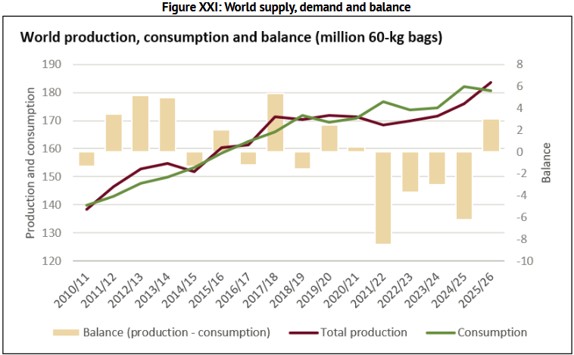
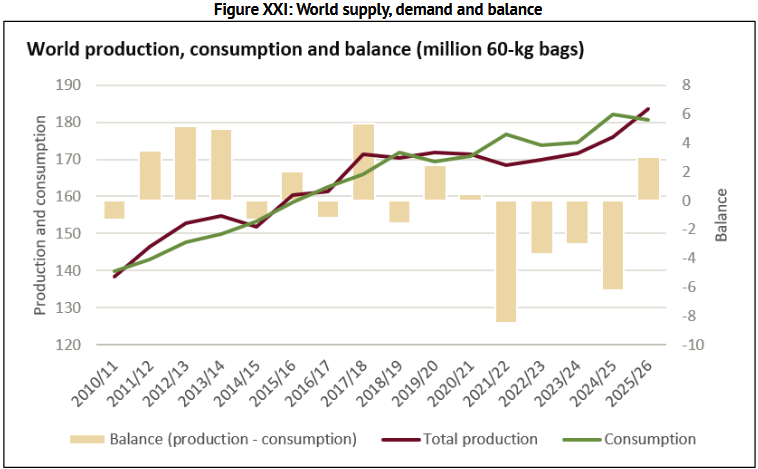
La OIC en su reporte de agosto menciona que en 2025/26 la producción aumentó 4.4% a un volumen récord de 183.6 millones de sacos. El consumo bajó en 0.9% a 180.6 millones, dejando un excedente de 3 millones de sacos, el primer excedente en 5 años.
En el blog pasado El Error analizamos el volumen de exportación mensual y anual de Brasil. Por un “error en el sistema” de Cenicafé la proyección de las exportaciones en agosto estuvo en menos de 3 millones de sacos. Corrigiendo el “error” de repente subió a cerca de 3.8 millones y luego 4.0 millones 

Los datos actualizados ahora por Cenicafé muestran que el volumen en agosto ha sido aun mayor: 4.2 millones de sacos, 31% más que en agosto del año pasado y 36% más que en julio. Es el volumen más alto jamás alcanzado en el mes de agosto, tanto en Arábica (2.9 millones, +26%) como en Robusta (1 millón, +54%), además de 300 mil sacos de café soluble. El récord anterior fue agosto 2024 con 3.8 millones de sacos.

Las condiciones en Brasil son favorables en esta etapa crítica de floración, pero el Niño puede cambiar el panorama. Vietnam aumenta la producción en cosecha 2025/26 6% a 29.4 millones de sacos. Las exportaciones en 2025 subieron 17.5% a 26.3 millones y de enero a agosto de este año otros 13.7 millones a 22.2 millones. Igual que en el caso de Brasil existe mucha incertidumbre en cuanto al impacto que tendrá sobre el nuevo ciclo el “Super Niño” que se está desarrollando.

Productores de Perú reportaron que el diferencial para Grado 1 ha subido hasta +70/+80, pero exportadores dicen que nadie lo está pagando. Ante la escasez de café y los altos precios en Perú, los compradores se han vuelto hace Honduras y el resto de Centroamérica.

Hay problemas con los bookings porque el Canal de Panamá tiene una capacidad limitada para transitar barcos por las esclusas debido a la sequía. El café se está acumulando en las plantas y los puertos, no obstante la reducción de la producción.

Investigadores de la Universidad de Viçosa y el Instituto Federal de Espírito Santo han descubierto bacterias que pueden fijar nitrógeno del aire, disolver fósforo y producir hormonas vegetales. Esto podría reemplazar fertilizantes sintéticos, reduciendo el impacto ambiental y financiero.

Compararon dos fincas en Minas Gerais con la misma variedad de café Catuaí Amarillo durante más de quince años. Una fertiliza con fertilizantes químicos, la otra con estiércol de gallinas. Se identificó 38 cepas de bacterias, entre ellas algunas locales desconocidas hasta el momento. La orgánica enriqueció el suelo con géneros ausentes en los suelos fertilizados con químicos.

Ver Brazilian Coffee Soils Harbor “Hidden Bacteria” That Could Revolutionize Sustainable Farming.

Jos Algra es consultor internacional con más de 40 años de experiencia en café y trabajar con organizaciones de productores.

Este blog fue publicado originalmente en Claase:
https://claase.org/analisis-de-los-precios-del-cafe

Testing the floor

Commentary, Sep 21, Jos Algra

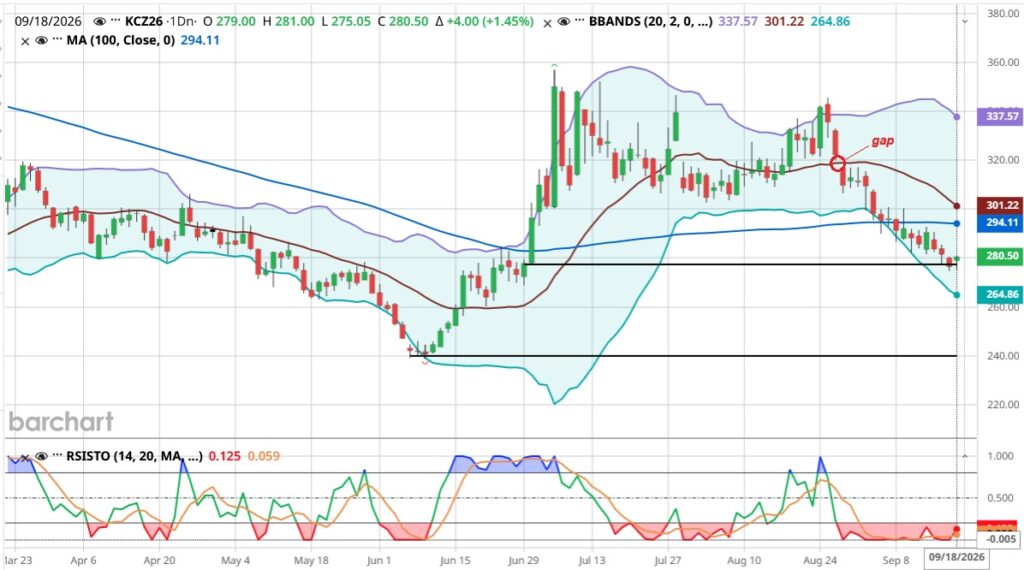
New York coffee prices continued their downward trend, breaking the 280 support level and touching a low of 274.60 on Thursday—the lowest price in two and a half months. On Friday, the price recovered 4 points to close at 280.50.

Coffee prices are facing increasing pressure from Brazil’s large harvest volume. The ICO also forecasts a surplus of 3 million bags—the first in five years. In August, Brazil exported 4.2 million bags, the highest level on record for that month.

On the other hand, certified New York inventories fell to 217,646 bags on Tuesday—a 27-year low—but by Friday, they had risen to 258,415 bags, surpassing levels seen a month and a half ago.

The New York market is heavily oversold—a condition that has persisted for nearly a month without triggering a price correction or a market rebound.

The 280 floor has been breached in recent days. It remains to be seen whether the support level around that mark can hold following Friday’s slight recovery. If not, prices could drop to the 260 and 240 levels.

To move higher, the price must first break above the 100-day moving average, currently at 294.10 cents.

Support: 274.60, 260.15, and 238.85. Resistance: 292.50, 300.25, and 316.90–319.80 (gap).

According to the Commitment of Traders report, combined futures and options Open Interest fell by 8,593 contracts over the last two weeks, dropping from 200,891 to 192,298. Futures-only open interest decreased by 3,680 contracts, from 155,275 to 151,575 as of last Thursday. Daily volume averaged 29.5 thousand contracts (ranging from 24.1 to 41.4 thousand).

The funds’ net position shifted by 8,861 contracts, moving from a net long of 7,145 to a net short of 1,716. Except for a brief moment in June of this year, funds have maintained a net long position since October 2023. Spreads – reflecting the extent to which non-commercial traders hold combined long and short positions – decreased by 6,952 contracts, falling from 72,227 to 65,275.

Commercials’ long positions rose by 3,334 lots, from 51,651 to 54,985, while their short positions fell by 6,950 lots, from 96,697 to 89,747.

Index funds reduced their net long position by 517 contracts, dropping from 35,654 to 35,137.

There is a palpable shift in the atmosphere of the New York market. After three years, funds have abandoned their bullish bets and adopted a net short position. Roasters continue to capitalize on the price drop to lock in contracts. Producers are further reducing their price fixings amidst the decline; they were forced to fix against the September contract and will eventually have to fix contracts against the December position. Many have incurred—and continue to incur—significant losses by delaying their price fixations, waiting for a price recovery. 

In its August report, the ICO notes that in 2025/26, production increased by 4.4% to a record volume of 183.6 million bags. Consumption fell by 0.9% to 180.6 million, resulting in a surplus of 3 million bags—the first surplus in five years.

In our previous blog post, The error we analysed Brazil’s monthly and annual export volumes. Due to a “system error” at Cenicafé, the projected export figure for August initially stood at under 3 million bags. Once the “error” was corrected, the figure jumped to nearly 3.8 million and subsequently to 4.0 million.

Updated data from Cenicafé now show that the August volume was even higher: 4.2 million bags, a 31% increase over August of last year and a 36% rise compared to July. This represents the highest volume ever recorded for the month of August across all categories: Arabica (2.9 million, +26%), Robusta (1 million, +54%), and 300 thousand bags of soluble coffee. The previous record was set in August 2024, with 3.8 million bags.

Conditions in Brazil remain favourable during this critical flowering stage, though the El Niño phenomenon could alter the outlook. Vietnam is increasing production for the 2025/26 harvest by 6%, reaching 29.4 million bags. Exports rose by 17.5% to 26.3 million in 2025, with an additional 13.7 million exported between January and August of this year, bringing the total to 22.2 million. As with Brazil, there is significant uncertainty regarding the impact the developing “Super El Niño” will have on the new crop cycle.

Producers in Peru have reported that the price differential for Grade 1 coffee has risen to +70/+80, though exporters state that no one is actually paying that rate. Faced with coffee shortages and high prices in Peru, buyers are turning to Honduras and the rest of Central America.

There are problems with the bookings, because the Panama Canal has a reduced capacity to lock ships through due to the draught and coffee is accumulating at the mills and ports, notwithstanding the reduction in production. 

Researchers from the University of Viçosa and the Federal Institute of Espírito Santo have discovered bacteria capable of fixing atmospheric nitrogen, solubilizing phosphorus, and producing plant hormones. This discovery could potentially replace synthetic fertilisers, thereby reducing both environmental and financial impacts. 

Two farms in Minas Gerais growing the same Yellow Catua coffee variety were compared over a period of more than fifteen years. One uses chemical fertilisers, while the other uses chicken manure. Thirty-eight bacterial strains were identified, including some local ones that were previously unknown. The organic method enriched the soil with genera that were absent from the chemically fertilised soils.

See Brazilian Coffee Soils Harbor “Hidden Bacteria” That Could Revolutionize Sustainable Farming.

Jos Algra is an international consultant with more than 40 years of experience in coffee and working with producer organisations.

This blog was originally published in Spanish in Claase:

https://claase.org/analisis-de-los-precios-del-cafe