Commentary, Nov. 1, Jos Algra
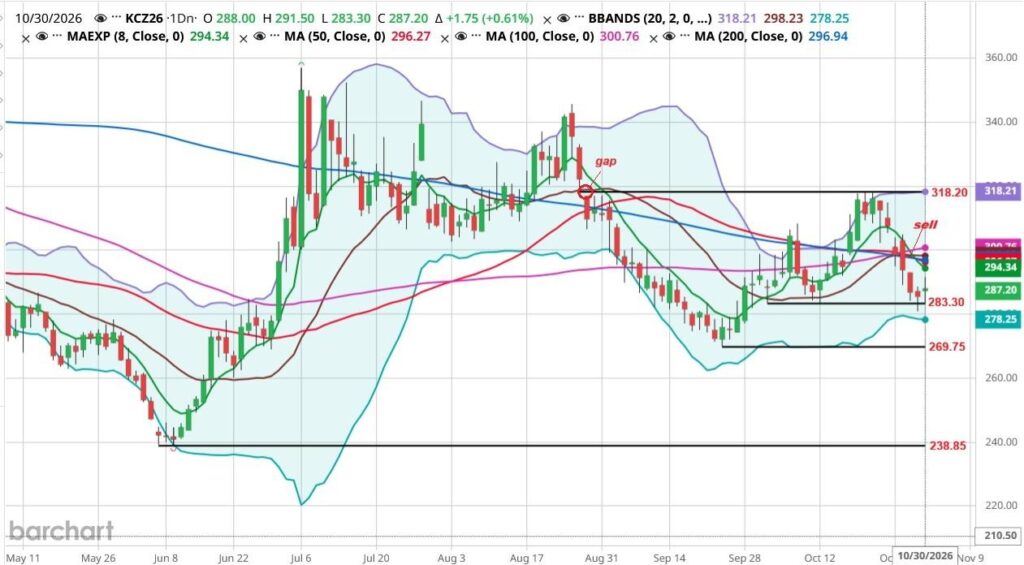
The price of coffee in New York has been on a rollercoaster ride for some time now, fluctuating between lows and highs between 269.75 and 317.90, a range of almost 50 cents, before finally closing at 287.20 cents on Friday.
The downward trend over the past week was due to the outcome of the presidential elections in Brazil, which was won by President Lula da Silva, where many had expected Flavio Bolsonaro, who was ahead in the first round, to win. Democracy won, the economy lost. The financial market reacted negatively, causing the Brazilian real to fall against the US dollar.
The exchange rate jumped from 5 to 5.4 reais per dollar, which incentivised producers and exporters to sell and fix large quantities of coffee, driving down the price on the New York Coffee Exchange. October exports in Brazil rose sharply, according to preliminary figures from Cecafé. However, it doesn’t yet significantly influence the certified inventories on the exchange, and therefore not influence the price formation.
Discounts for futures positions have widened slightly again, so the market remains in backwardation for the time being (see the October 18 blog post, The end of backwardation?).
The price rose slightly on Friday (+1.75), but the candlestick is practically a doji, meaning the market is undecided about whether to move the price up or down. On Thursday, it gave a sell signal, and the price has fallen below the 50, 100, and 200-day moving averages (all in the 296-301 range), indicating a downward trend. Key support levels are just below 270 and 240.
Support: 299.95 (MA50), 292.60, 283.50, 280.80, 269.75, 260.15, and 238.85. Resistance: 298.25 (pivot), 304.90, 317.00-319.80 (gap), and 333.05.
The Commitment of Traders report on Friday shows that sentiment on the New York Exchange was slightly more upbeat, but with the price decline this week, a reversal of this trend can be expected in the next report.
Combined futures and options Open Interest rose 17,614 contracts, from 201,085 to 218,699. Futures-only Open Interest rose like the previous two weeks, from 166,525 to 170,306 last Thursday, an increase of 3,781 contracts. Daily volume averaged slightly less than 40 thousand bags.
The net short position of funds first decreased by 2,678 contracts, from 3,697 to 1,019. The Spreads, which reflect the degree to which each non-commercial trader holds combined long and short positions, increased by 15,096 contracts, from 69,336 to 84,432, reflecting that many funds have not yet decided whether to add more long or short positions.
The long position of commercials remained virtually unchanged, from 59,679 to 59,644. The short position of commercials initially increased from 91,170 to 97,650 (the week of the price rise), but then decreased to 94,699 (the week the price began to fall).
There was little change in the position of Index Funds, they increased their net long position by 380 contracts, from 34,518 to 34,898.
Brazilian coffee exports rose to 4.7 million bags in October, according to preliminary figures from Cecafé, 21% higher than in September and 13% higher than in October of last year. This is the third highest level since October 2024 (5.2 million) and November 2020 (4.8 million). Final figures, after the closing of registration, are usually higher.
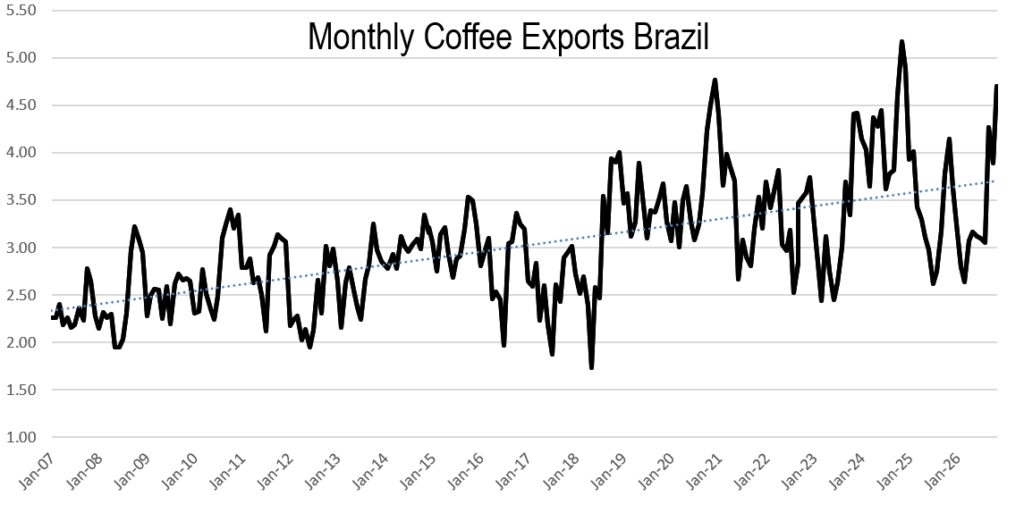
The chart shows a clear upward trend in the monthly volume of coffee exports, from an average of less than 2.5 million bags 20 years ago to 3.5 million currently. Annually, this represents a 50% increase, or 14 million bags, from 28 million to an average of 42 million over the last five years.
The increase in exports will continue and strengthen in the short term, judging by the issuance of certificates of origin: 5.2 million bags in October, 28% more than the 4.1 million in October 2025 and last September.
At some point, this coffee will also reach the warehouses of the New York Futures Market and will begin to put pressure on the price. More than 80% of the 225 thousand bags as of Friday are in Europe, mainly in Antwerp. Brazil represents 37% of this volume with 83 thousand bags, and there are 47.5 thousand bags pending grading.
Brazilian coffee can reach Europe in a minimum of 20 days; valuing and certifying it can take several weeks if the volume is large. This means that in two months from now, the situation could be very different. The volume to be certified will also depend on the differentials for washed and semi-washed Brazilian coffee (in New York, the differential is -6) and on the premiums for the first position over future positions.
Vietnam’s coffee exports in September were up 53% compared to last year. Export volume in 2025/26 was 33 million bags, exceeding production of over 30 million bags. This suggests that Vietnam has been clearing out stocks from previous harvests.
Certified Robusta stocks on the London Futures Market increased significantly in October to over 1.1 million bags, and the price fell to around 3,200 dollars per tonne, the lowest level since early 2024. Arbitrage with Arabica coffee is currently around 120-130 cents/lb, incentivising roasters to change their blends and increase the percentage of Robusta.
Jos Algra is an international consultant with more than 40 years of experience in coffee and working with producer organisations.
This blog was originally published in Spanish in Claase: