Commentary, Oct. 18, Jos Algra
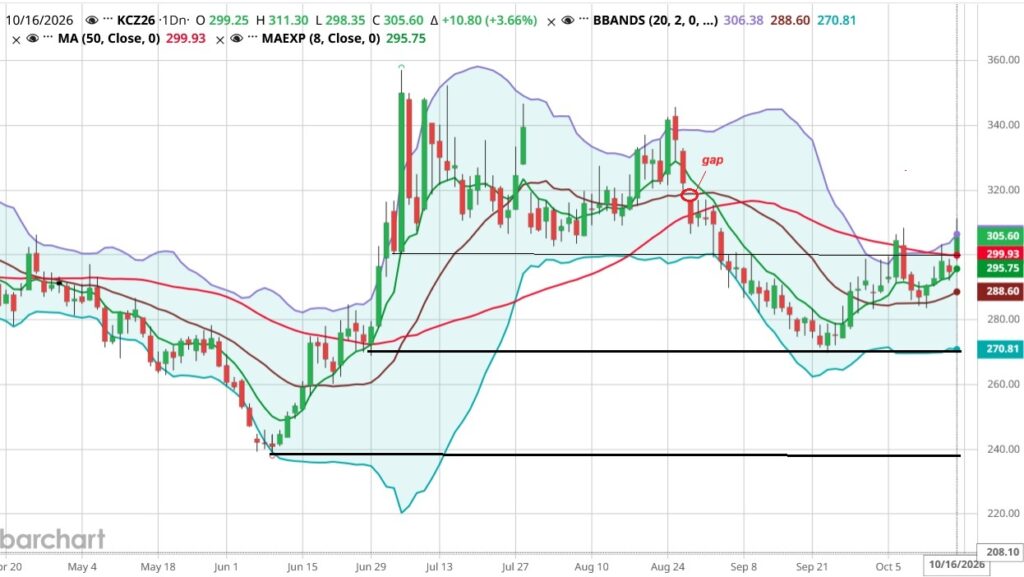
The price of coffee in New York saw a strong boost on October 6, rising 11.40 cents to close at 304.45. The following day, it climbed further to 308.35, but then plummeted, closing at 292.70. In the days that followed, it hit a low of 283.30, but it rebounded this week, most notably on Friday, when it reached 311.30 and closed at 305.60, an increase of 10.80 cents for the day.
Initially, the price rose due to concerns regarding the potential impact of a “Super El Niño” on coffee production in major producing nations such as Brazil, Vietnam, and Indonesia later this year.
Compounding this was the strengthening of the Brazilian real against the U.S. dollar, driven by the fact that right-wing candidate Flavio Bolsonaro – son of former president Jair Bolsonaro, who is currently imprisoned for an attempted coup – led in the first round of the presidential elections against current President Lula da Silva. A stronger real tends to discourage producers from selling their coffee for export.
Subsequently, market sentiment shifted due to expectations of a significant surge in exports for the current harvest, as well as an increased supply of coffee from Brazil for the upcoming season.
Last Friday, Colombia’s National Federation of Coffee Growers FNC reported a notable decline in both coffee production and exports for the 2025/26 cycle. This news fuelled the price increase seen this week.
After a price drop on Thursday, there was a sharp rally on Friday, driven by renewed concerns regarding the impact of El Niño. Vietnam’s Ministry of Agriculture indicated that the country could face severe drought conditions between late 2026 and early 2027, a period that coincides with the peak of the harvest season.
The price has broken through the psychological resistance level of 300 cents, reaching a high of 311.30 on Friday. The next resistance level is the gap between 317.00 and 319.80, which has persisted since late August. The market remains in a buying mode, though it is slightly overbought, which could lead to a correction.
Furthermore, there are indications that the state of backwardation may be coming to an end, a development that would alter the price outlook, as discussed further on.
On the downside, there are several support levels; the first is the 50-day moving average at 299.95, which was surpassed on Friday, as was the 100-day moving average at 296.15. Significant support floors lie just below 270 and 240.
Support: 299.95 (50-day MA), 292.60, 283.50, 269.75, 260.15, and 238.85. Resistance: 311.30, 317.00–319.80 (gap), and 333.05.
In the Commitment of Traders report, the combined Open Interest for futures and options first rose from 197,518 two weeks ago to 208,283 last week, but subsequently fell to 201,085, a net increase of 3,567 contracts. Open Interest for futures alone followed a similar trend to the previous two-week period, rising from 157,890 to 166,525 as of last Thursday, an increase of 8,635 contracts. Daily volume averaged nearly 33 thousand contracts and picked up on Friday, reaching over 53 thousand.
The position held by funds first narrowed from a net short of 3,493 to 1,160, but then widened again to a net short of 3,697, a net change of -204. Spreads, which reflect the extent to which each non-commercial trader holds a combination of long and short positions, increased by 1,873 contracts from 67,463 to 69,336.
The long position held by commercial traders first rose from 59,573 to 61,030, but then fell to 59,679, a net change of 106 contracts. The short position held by commercial traders first rose from 91,004 to 95,551, but then fell to 91,170, a net change of 166 contracts.
Index funds increased their net long position by 578 contracts, moving from 33,943 to 34,518. Sentiment on the New York exchange continues to improve, and with this week’s price increases, a significant shift is expected in next Friday’s Commitment of Traders report.
Typically, a futures market for a commodity like coffee operates in contango, where future positions carry a premium to offset the costs of carrying the product, such as storage, insurance, and interest. In the recent history of the coffee market, this premium has generally been 2–3 cents between consecutive contract positions. The price difference between these positions is known as a spread.
In my February 8th blog post, End of the bonanza?, I analysed how the coffee market has been in backwardation since October 17, 2023. In other words, the market is inverted: rather than a premium, there is a discount for future positions. Near-term positions command a premium due to a short-term scarcity of coffee.
This atypical situation has persisted for 775 trading days or 1,095 calendar days (3 years), marking the longest such period in history. The second-longest instance occurred between 1996 and 1998, lasting 527 trading days (842 calendar days).
A market in backwardation is more challenging for the trade to navigate and generally tends to drive up price levels due to short-term shortages. This situation may soon come to an end, which should lead to a decline in overall price levels. According to forecasts, the coffee scarcity experienced in recent years is set to shift toward a surplus of approximately 10 million bags. This change in the supply-demand balance is currently being reflected in prices on the New York exchange.
The discount of the second contract position in New York (currently March) relative to the first position (December) is narrowing. From a high of 36.10 cents as recently as August of this year, the figure has fallen to 7–8 cents over the last month, following the shift from the September to the December contract as the primary position, though it ticked back up to 10–11 cents on Thursday and Friday.
The discount for the full year has narrowed from a peak of 75.55 cents to an average of 15–16 cents of late. These prices reflect a sustained easing of the immediate shortage of Arabica coffee in the physical market.
In its latest crop forecast, CONAB reports 2.35 million hectares under coffee cultivation, with an average yield of 34.6 60-kg bags per hectare—an increase of 13.8%. Furthermore, more than 400,000 hectares are currently in the development phase. This points to a production potential of 75–80 million bags by 2027/28, and over 90 million by 2029/30.
The average of crop estimates for Brazil for 2026/27 stands at 72–73 million bags. Excluding figures from CONAB (67.6 million) and the IBGE (66.8 million)—sources known to consistently underestimate production volume—the average rises to 73–74 million bags. Adding initial inventories of 7–8 million bags brings the total supply to 79–82 million bags.
Subtracting domestic consumption of 22 million bags leaves a balance of 57–60 million bags. An ending inventory of 9–10 million bags is expected, leaving an exportable surplus of 48–50 million bags, compared to an export volume of 38.5 million bags in the 2025/26 cycle. This represents an increase of 25–30% and exceeds the previous record of 47.4 million bags from the 2023/24 harvest.
This will exert significant downward pressure on global coffee prices. It will be important to monitor monthly export volumes to track how much coffee is actually reaching the market. An annual total of 48–50 million bags translates to 4–4.2 million bags per month. So far this cycle (July–September), the average has been 3.7 million bags per month.
The National Federation of Coffee Growers of Colombia FNC reports a 15% decline in production, down to 12.7 million bags for the most recent harvest (covering the period from October 2025 to September 2026). Exports fell by 12% to 11.8 million bags.
Jos Algra is an international consultant with more than 40 years of experience in coffee and working with producer organisations.
This blog was originally published in Spanish in Claase: